
Laser cutting machines have changed the game in modern manufacturing. They use laser technology to cut materials with unmatched precision. This has made a big difference in many industries, from making car parts to building aircraft.
These machines work by focusing a laser beam on the material. This allows them to cut through metals, plastics, and more with great accuracy. This precision not only makes products better but also makes making them faster and cheaper.
Key Takeaways
- Laser cutting machines leverage advanced laser technology to deliver unparalleled precision and accuracy in manufacturing processes.
- These machines can handle a wide range of materials, from metals to plastics, with exceptional cutting capabilities.
- The precise control and consistency of laser cutting contribute to improved product quality, increased productivity, and cost-effective manufacturing.
- Laser cutting technology has transformed industries by enabling the fabrication of complex geometries and intricate components with remarkable precision.
- The integration of laser cutting machines into modern manufacturing workflows has revolutionized the way industries approach precision and efficiency.
Understanding Laser Cutting Technology Fundamentals
The world of industrial manufacturing has changed a lot with advanced laser cutting technology. At its core, we find the basic principles of fiber laser cutting machines and laser cutting systems. Exploring the main parts, types of cutting methods, and how they work gives us a deep look into this technology’s power and precision.
Core Components of Laser Cutting Systems
Laser cutting systems have key parts that work together for top performance. The laser source creates the intense beam, and the beam delivery system guides it. The cutting head focuses the beam on the material. A computer numerical control (CNC) system moves the cutting head for precise cuts.
Types of Industrial Laser Cutting Methods
- Oxygen Cutting: Uses pure oxygen for cutting thick metal sheets.
- Nitrogen Cutting: Prevents oxidation with inert nitrogen gas, great for stainless steel and alloys.
- Fiber Laser Cutting: Uses fiber optic technology for high precision, speed, and efficiency.
Basic Operating Principles
Laser cutting works on the principle of focused energy. The laser beam heats and melts the material quickly. This method allows for detailed and clean cuts, even in complex shapes. The choice of assist gas, cutting speed, and other settings are adjusted for the best results.
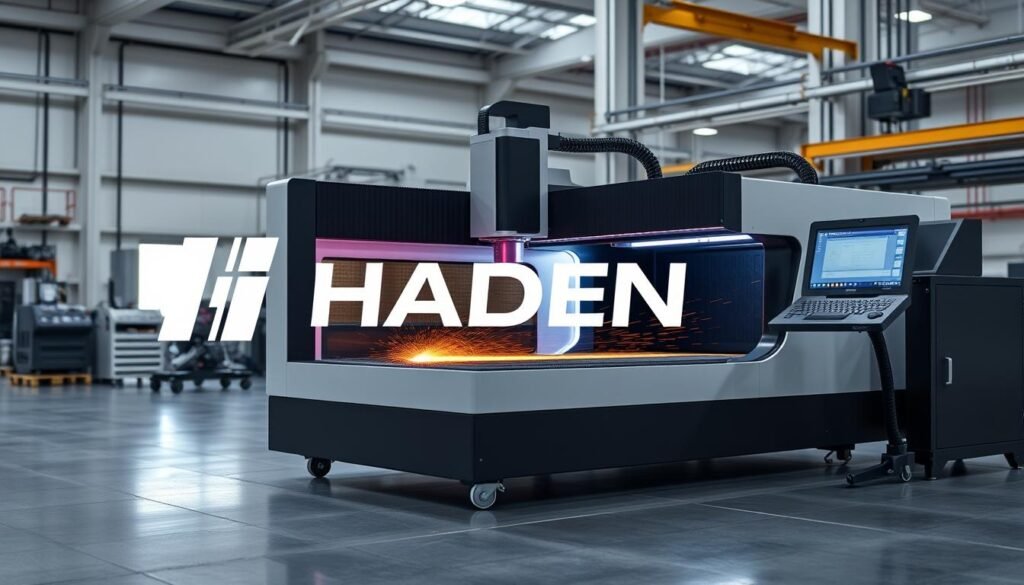
Knowing the basics of laser cutting technology helps manufacturers use it to its fullest. This unlocks new levels of precision, efficiency, and innovation in industrial processes.
Evolution of Fiber Laser Cutting Machine Technology
The world of cutting machines has changed a lot, thanks to fiber laser technology. Fiber lasers have made cutting more precise and efficient in many fields.
In the last ten years, fiber laser cutting machines have gotten much better. They cut faster, more accurately, and use less energy. This makes them a top choice for today’s factories.
Fiber laser cutting machines have always been at the forefront of cutting machine advancements. They’ve introduced high-power lasers and better control systems. This has led to many new ideas in the field.
“The integration of fiber laser technology has changed how we cut things. Now, we can be more precise and productive than ever before.”
The need for better precision and efficiency in making things has grown. Fiber laser technology has become key in this change. It has helped factories make complex parts, process materials better, and save money.
| Feature | Traditional Laser Cutting | Fiber Laser Cutting |
|---|---|---|
| Cutting Speed | Moderate | Faster |
| Precision | Good | Excellent |
| Energy Efficiency | Moderate | Higher |
| Maintenance | More Frequent | Less Frequent |
The growth of fiber laser cutting machine technology keeps improving cutting machines. It’s changing the manufacturing world and shaping the future of making things with precision.
Key Benefits of Metal Laser Cutting Machine Precision
Metal laser cutting machines are key in today’s manufacturing. They offer unmatched precision and versatility. These systems improve production and meet the needs of many industries.
Accuracy in Complex Geometries
Metal laser cutting machines are great at cutting complex shapes. They can cut intricate designs with high accuracy. This means manufacturers can make parts that meet strict design standards.
Material Thickness Capabilities
These machines can work with many material thicknesses. They can cut from thin sheets to thick plates. This makes it easy to work with different materials like steel, aluminum, and titanium.
Surface Finish Quality
Another benefit is the surface finish quality. The laser cuts with precision, leaving clean edges. This means less need for extra work and a better-looking product.
| Benefit | Description |
|---|---|
| Accuracy in Complex Geometries | Metal laser cutting machines can precisely cut intricate shapes, curves, and patterns with remarkable consistency. |
| Material Thickness Capabilities | These machines can handle a wide range of material thicknesses, from thin sheets to thick plates, without compromising quality. |
| Surface Finish Quality | Metal laser cutting machines produce clean, burr-free edges, resulting in a smooth, professional-looking final product. |
Using metal laser cutting machines boosts production. It helps use materials better and makes high-quality parts. These parts meet the highest industry standards.
Advanced Control Systems in Modern Cutting Machines
CNC laser cutting machines have become more precise and efficient thanks to advanced control systems. These systems are key to improving how laser cutting works today.
At the core of these systems are integrated computer numerical control (CNC) modules. CNC technology lets us control the laser head’s movement and position. This ensures accurate cuts, even on complex shapes. The mix of CNC and laser cutting has changed the game, bringing us a new level of precision and productivity.
Modern laser cutting machines also have advanced sensors and feedback systems. These systems watch over things like laser power, cutting speed, and material thickness. They make adjustments in real-time to keep the cutting perfect. This means better quality, less waste, and more efficiency.
| Key Features of Advanced Control Systems | Benefits |
|---|---|
| Integrated CNC modules | Precise control over laser head movement and positioning |
| Advanced sensors and feedback mechanisms | Real-time parameter monitoring and adjustment for optimal cutting |
| Automation and programmable control | Increased productivity, reduced human error, and consistent quality |
| Machine learning algorithms | Predictive maintenance, process optimization, and intelligent decision-making |
These advanced control systems have made CNC laser cutting machines even better. By using the latest technology, makers can get unmatched accuracy, efficiency, and cost savings in their laser cutting work.
“The integration of advanced control systems has been a game-changer for the laser cutting industry, enabling us to push the boundaries of precision and productivity.”
Laser for Cutting Machine Applications Across Industries
Laser technology has changed how we make things in many fields. It’s used in making cars, parts for planes, and medical tools. This technology is very useful because it can cut things with great precision.
Automotive Manufacturing Solutions
In car making, industrial laser applications are key. They help make car parts with perfect fit and look. This tech makes it possible to create detailed car parts quickly and accurately.
Aerospace Component Production
The space industry also benefits a lot from laser cutting machine tech. It’s used to make parts for planes and spaceships. This tech makes it easier to work with different materials, improving quality and speed.
Medical Device Fabrication
In medicine, lasers are used to make special tools and implants. They help create parts that are both precise and safe for the body. This is crucial for making life-saving medical tools.
| Industry | Key Applications | Benefits of Laser Cutting |
|---|---|---|
| Automotive | Body panels, engine parts, structural components | Precision, efficiency, complex geometries |
| Aerospace | Aircraft and spacecraft components, lightweight alloys, composites | Precision, flexibility, material versatility |
| Medical | Surgical instruments, prosthetics, implants | Accuracy, biocompatibility, intricate designs |
The use of industrial laser applications keeps improving how we make things. As technology gets better, lasers will help us make even more precise products. This will change how we make the things that shape our world.
Maximizing Cutting Precision Through Parameter Optimization
In laser cutting, precision is key. To get the best results, manufacturers need to adjust important settings. These include laser power settings, cutting speed, and focal length.
Changing the laser power affects how precise the cuts are. More power means faster cuts but might not be as clean. Finding the right balance is crucial for perfect cuts.
The speed at which you cut also matters a lot. Going slower can make cuts more precise but takes longer. Experts look for the best speed to balance speed and precision.
The focal length of the laser is also important. Keeping the right distance between the nozzle and the workpiece is key. This ensures the beam is sharp, leading to better cuts.
| Cutting Parameter | Impact on Precision | Optimization Approach |
|---|---|---|
| Laser Power | Higher power enables faster cutting but may compromise edge quality | Find the optimal balance between power and speed |
| Cutting Speed | Slower speeds yield tighter tolerances and better edge finishes | Analyze trade-offs to maximize both efficiency and precision |
| Focal Length | Maintaining ideal nozzle-to-workpiece distance ensures sharp beam focus | Carefully adjust focal length to optimize power density and cutting accuracy |
By carefully adjusting these settings, manufacturers can get the most out of their laser cutters. This leads to parts that are both accurate and of high quality. This focus on laser cutting optimization is essential for improving efficiency and meeting today’s industrial needs.
Integration of CNC Technology with Laser Systems
The mix of CNC (Computer Numerical Control) tech with laser cutting has changed the game in manufacturing. It combines CNC’s precision and automation with laser’s cutting power. This combo boosts efficiency, accuracy, and productivity in making things.
Software Integration Benefits
Linking CNC with laser cutting systems brings many benefits. Advanced CAD/CAM software makes moving designs to the laser machine smooth. This ensures parts are made accurately and consistently.
Also, systems that monitor and control in real-time help operators tweak the cutting process as needed. This keeps the quality and speed up.
Machine Learning Applications
Adding machine learning to laser cutting systems takes things to the next level. It uses data analysis and predictive models to find the best cutting settings. It also spots problems before they happen and adjusts the system to keep quality high.
This mix of CNC, laser cutting software, and machine learning has changed how industries cut materials. It’s a game-changer.
| Feature | Benefit |
|---|---|
| Seamless CAD/CAM integration | Precise and consistent part production |
| Real-time monitoring and control | Improved process optimization and quality control |
| Machine learning algorithms | Enhanced cutting precision, efficiency, and predictive maintenance |
“The integration of CNC and laser cutting technologies, coupled with the power of machine learning, has revolutionized the way we approach manufacturing. The precision, automation, and optimization capabilities of these systems have truly transformed the industry.”
– Industry Expert, XYZ Manufacturing
Material Considerations for Laser Cutting Operations
Laser cutting is a versatile technique that works with many materials. These include metals, plastics, and composites. The material’s properties greatly affect the cutting quality and precision. Knowing these factors is key for better laser cutting in various industries.
When looking at laser cutting materials, important properties are thermal conductivity, melting point, reflectivity, and thickness. For example, stainless steel cuts cleaner than aluminum because it has lower thermal conductivity. Titanium, with a higher melting point, needs more energy to cut well.
The reflectivity of a material also matters. High reflectivity can scatter the laser, causing uneven cuts. To fix this, special laser techniques are used. These include shorter wavelengths or pulsed systems to improve cutting performance on reflective materials.
Material thickness is another key factor. Thicker materials need more powerful lasers and slower speeds for clean cuts. It’s important to match the material’s properties and thickness to the laser cutting task for the best results.
| Material | Thermal Conductivity (W/m·K) | Melting Point (°C) | Reflectivity (%) | Cutting Performance |
|---|---|---|---|---|
| Stainless Steel | 16.2 | 1,400-1,450 | 60-70 | Excellent |
| Aluminum | 237 | 660 | 90-95 | Good |
| Titanium | 22 | 1,670 | 50-60 | Moderate |
| Acrylic | 0.19 | 160 | 4-6 | Excellent |
Understanding the material properties and their effects on laser cutting is crucial. This knowledge helps manufacturers improve their processes. It leads to better precision and quality in products across many industries. These include automotive, aerospace, and medical devices.
Future Trends in Laser Cutting Technology
The future of laser cutting technology looks very promising. New technologies and the integration of Industry 4.0 will change how we cut materials. This will make cutting more precise and efficient in many industries.
Emerging Technologies
New technologies are changing the laser cutting world. Fiber laser systems are getting better, offering high quality and energy savings. This lets manufacturers cut complex shapes with great accuracy.
Artificial intelligence and machine learning are also making a big impact. They help cutting systems work better on their own. This reduces waste and improves control over the cutting process.
Industry 4.0 Integration
Laser cutting is becoming part of Industry 4.0. This means machines can talk to data analytics and other systems in real time. It helps manufacturers work smarter, cut downtime, and boost efficiency.
With cloud solutions and remote access, companies can make better decisions. They can stay ahead in the industry by using data effectively.